The 2025 season
REEFSCAPE, the 2025 game, rewards fast coral cycles. Walton 2974 ran the season as an Open Alliance team, sharing its CAD, code and progress in a public build blog, with events planned at Dalton in week 2 and Statesboro in week 4.
Kickoff was a joint effort with teams 1002 and 1261. Together they read the rules, listed the strategic options, and ranked what the robot needed: what had to work by the first event, what came next (a deep climb first among them), and what would be nice to have without steering any design.
My role
I served as Chief Engineer from 2022 to 2025, leading 13 varsity and 7 junior engineers inside a program of more than 40 members. I directed the design and manufacturing of the shooter and telescoping-arm subsystems, built the team’s competition pit from scratch, and wrote technical documentation the team published for other teams to learn from.
The decisions and photos below are from the 2025 season specifically: team engineering, credited to the team, inside a role I led across all four years.
From requirements to prototypes
Decision matrices for the coral intake, the algae intake and the climber narrowed the options. Three coral intakes went to CAD: an over-the-bumper design, a Y-shaped one and an expanding U. The algae intake started from the team’s own 2019 design.
The CAD review was blunt. The U-shape risked jamming when picking a coral up off the floor, and neither the over-the-bumper nor the ground intake had any way to score. The Y-shape, with compliant star rollers that quickly reorient and grip the coral, came out ahead.
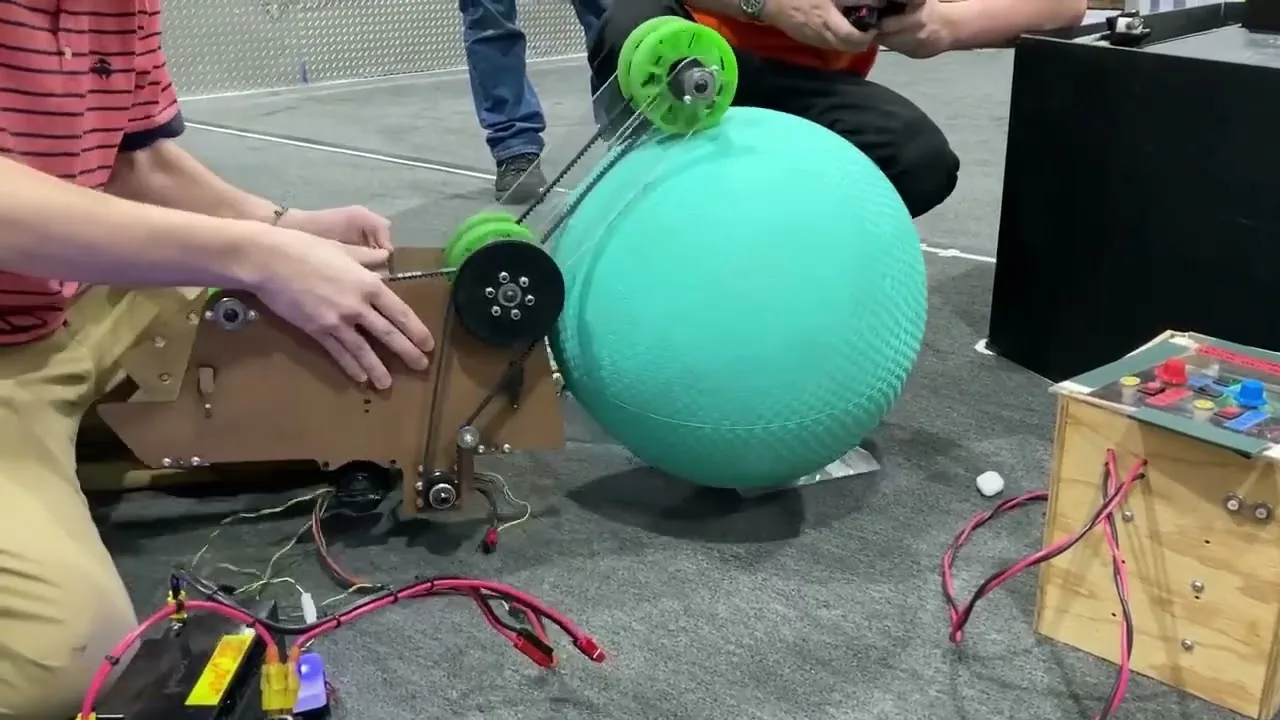
For algae, the team laser-cut an adjustable-width prototype to find the right compression. A gap of 11⅞ inches between wheel edges held the algae well, and mounting the wheels top and bottom instead of side to side kept it better aligned. The prototype moved from drills to motors as the plates were recut.
Designing around cycle time
The first full-robot CAD was organised around one goal: the shortest possible coral cycle. Intake and outtake sit on a single path parallel to the elevator, an idea the team credited to team 3512, so the drivetrain hardly needs to turn between pickup and scoring. With the coral mechanism on the carriage weighing about 7 lb before pocketing, the elevator could reach L4 height in just over half a second.
Because the chute sits at a fixed angle, scoring on L4 needed three elevator stages. The team chose a continuous-belt elevator so it never has to lift the weight of extra stages. The algae mechanism went on a chassis-mounted pivot instead of the carriage, since added carriage weight would slow every coral cycle. That gave up some scoring flexibility for a lighter, faster-cycling coral system, the right trade for a robot that lives or dies on cycle time.
A first algae design built like a shooter, tested with Krakens on 4:1 gearboxes, didn’t throw far enough. The team switched to a lighter bar-style mechanism, about 14 lb against roughly 21 lb for the shooter version.
Testing the details
The coral chute was laser-cut and assembled first, so the design could be tested before committing to aluminum. Its wheels started on a 4:1 reduction that proved too fast to control cleanly, so the team moved to 7:1 and got a mechanism that behaved the way the drivers needed.
The algae finger’s first motor was hard to modulate: above about 10% power it snapped from up to down. Swapping it for a slower window motor (about 92 rpm), with an encoder on the belt and a revised mount, turned it into something a driver could finesse.
The swerve modules changed from L3 to L2 gearing as well. A game of short cycles doesn’t need L3 speed.
Physical integration
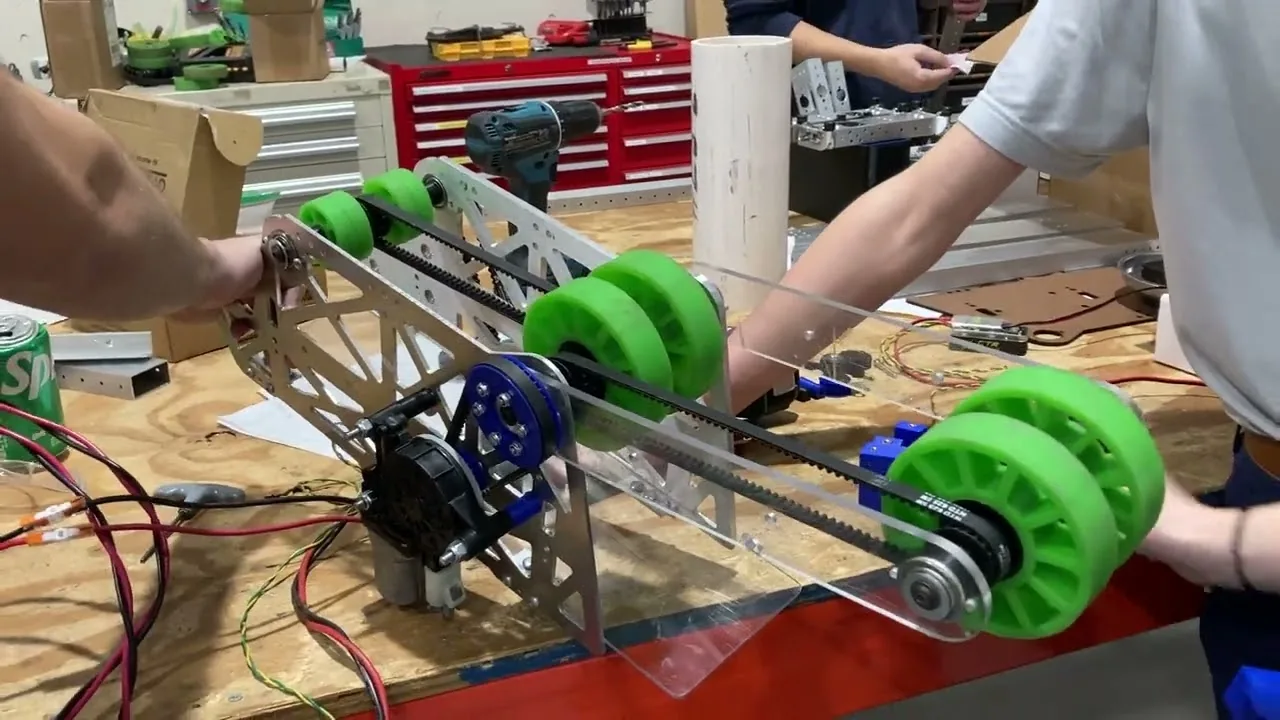
By February 22nd the elevator and chassis were assembled, the coral mechanism was wired, and the robot was powered up for the first programming pass. The photo below is from that handoff: full frame, temporary wiring and all, because that’s what an in-progress robot actually looks like.
Elevator and cable routing
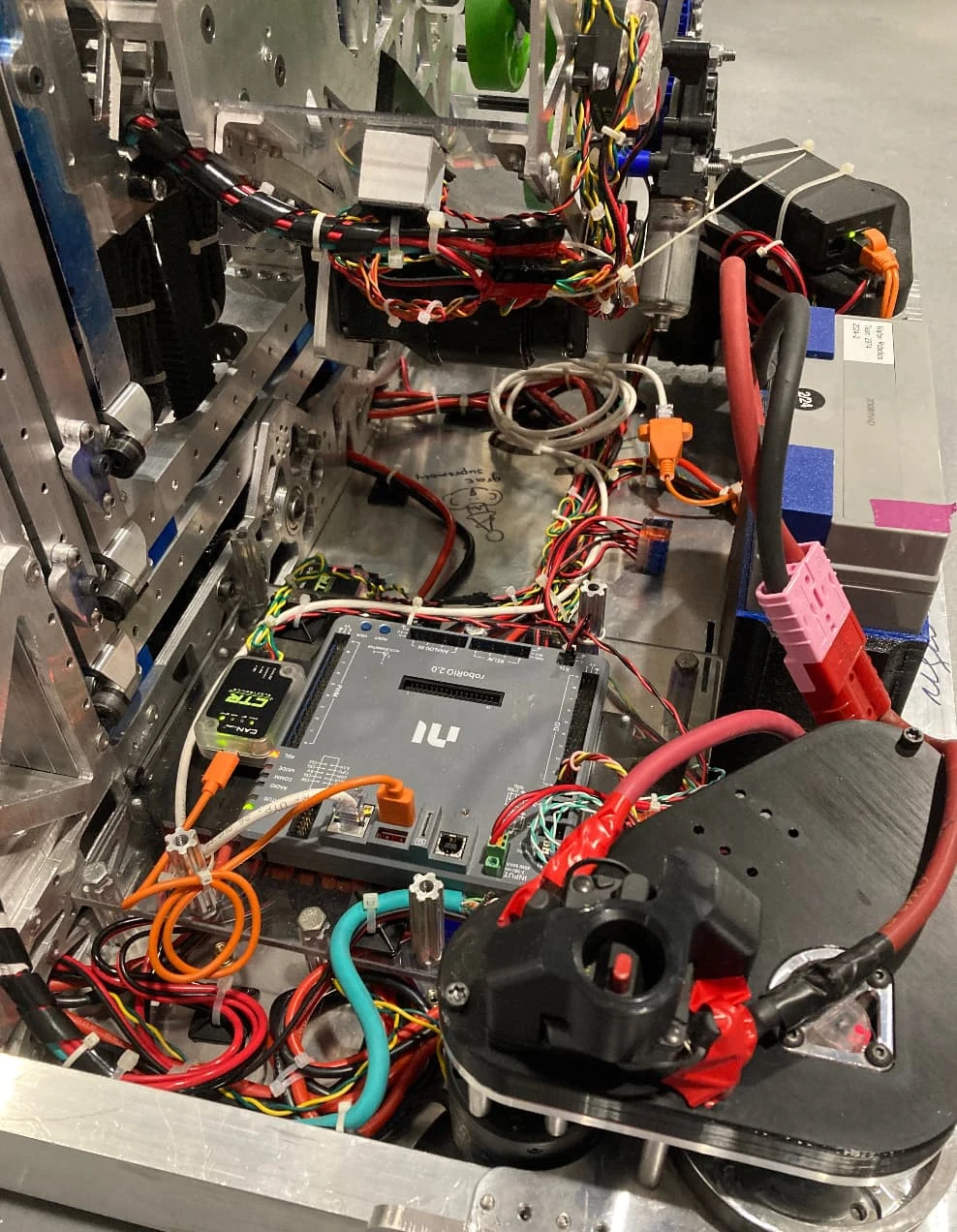
The elevator carries the coral mechanism through its full range of motion, which means its cable routing has to survive constant flexing without snagging. This shot captures that routing uncropped, straight from the build.
The first energy chain shattered under that flexing, so the team moved to a larger, stronger one and reset the lengths and mounts to keep it in a single plane.
The climber
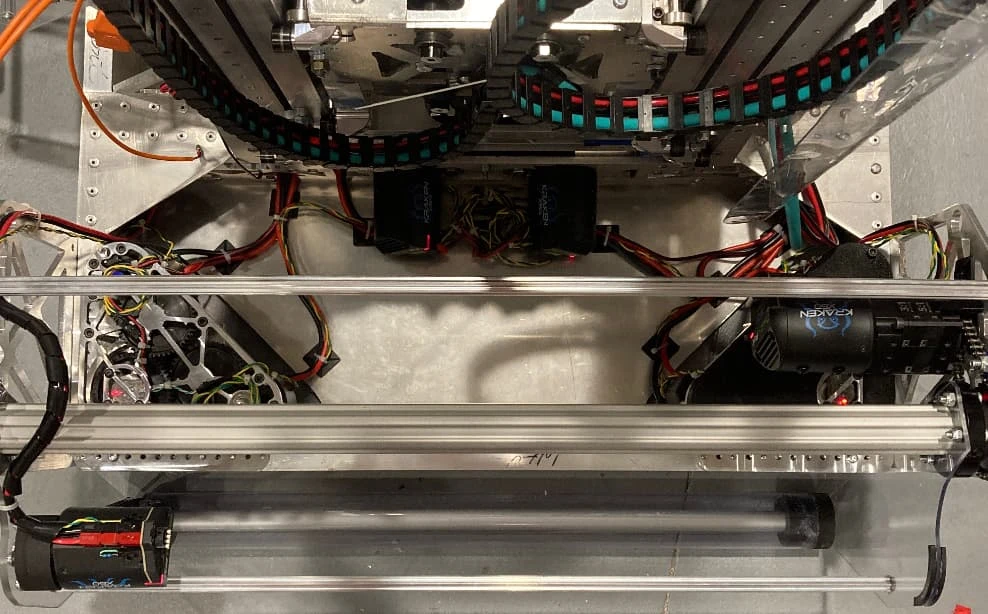
No subsystem changed shape more than the climber. It began as a pivot arm with two pegs and a winch, modeled on another team’s design. Space on the robot pushed the team toward an Everybot-style climber that uses the elevator to lift: an extension off the coral chute hooks the cage, and the elevator pulls the robot up.
Early hardware climbed the shallow cage and held up to 150 lb, but the deep cage was a friction problem between the polycarbonate plates. The next design was a two-piece latch, a lower guide that orients the cage plus spring-loaded wings held out by rubber bands, and it climbed faster and more efficiently than any version before it.
Before the district championship the team made a call. Lining up on the cage was taking drivers about 20 seconds, too long to be worth it. The climber and its braking gearbox came off, which freed the weight to make the limit and to put into a better intake funnel.
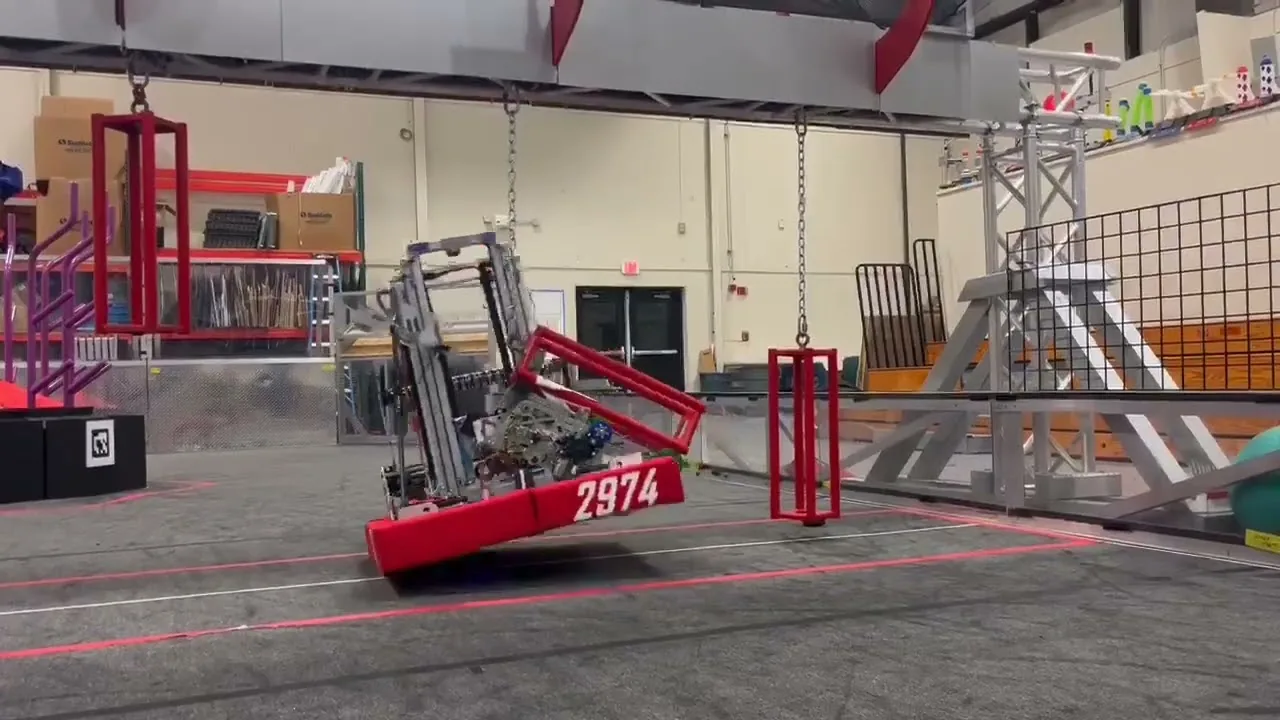
Practice, then Dalton
A small reef built for the pit let the team practice scoring wherever they were. Walton went on to win the Dalton event with captain 6919 and partner 10376.
Between events the team added a mini PC and two cameras to work on autonomous routines, one on the elevator and one on a swerve module, both looking at where the coral leaves the chute.
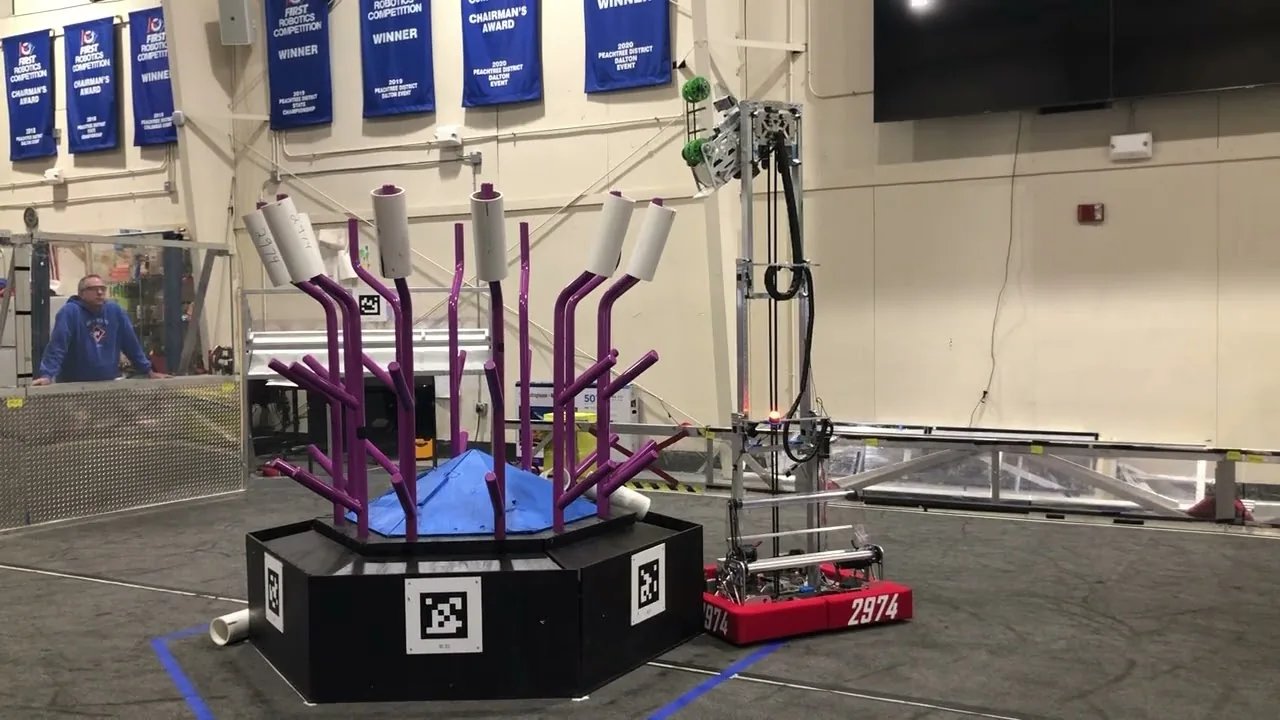
Statesboro and the district championship
At Statesboro, the first qualifier ever held there, Walton won alongside 8866, 4701 and 5219 in a 2–1 final. Impacts twisted the algae intake, and an elevator clamp fixed the stability problem but added weight the team had to account for elsewhere. The team then competed at the district championship on an alliance with 1261 and 7538.
Feeding from the human player station was the slowest part of the cycle, so the funnel grew from a short, narrow opening to one 10 inches tall and 14.5 inches wide with a top plate, and later gained a roller of compliant star wheels at its mouth, driven by a NEO 550. Moving coral in got much quicker.
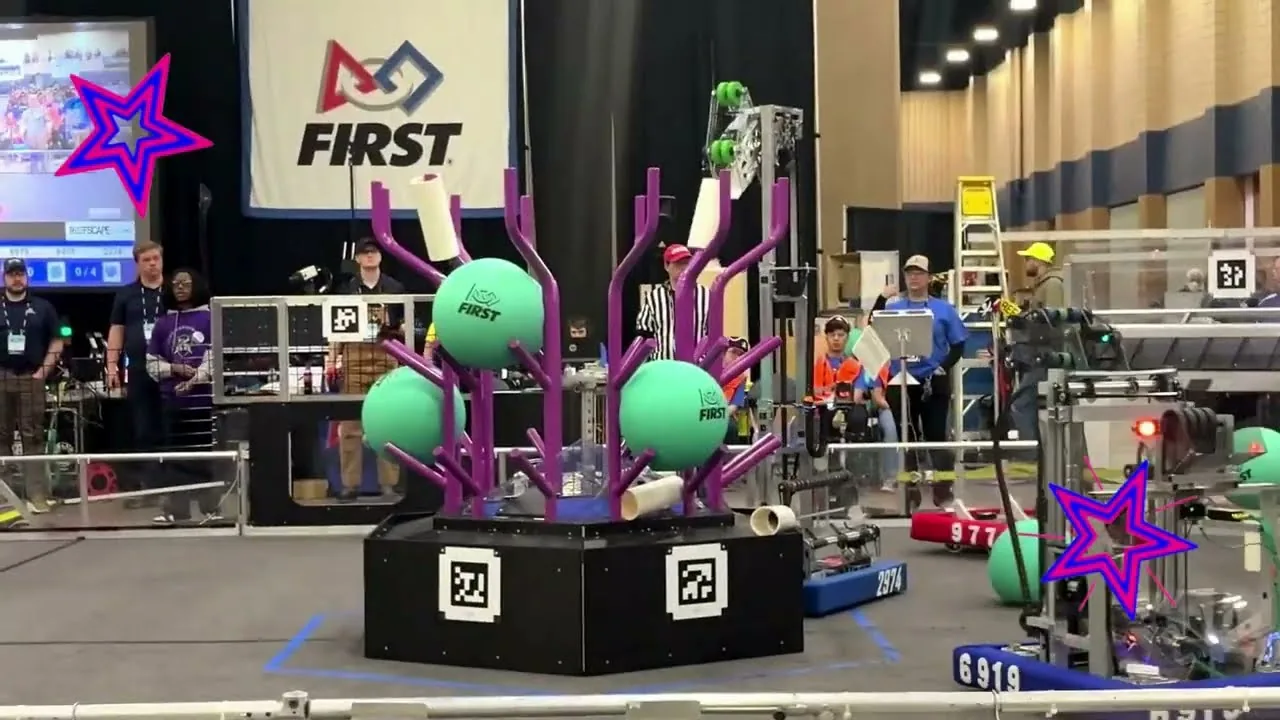
Small fixes that mattered
The coral’s sharp edges kept digging into the outtake floor, so polycarbonate gave way to half-inch HDPE, and a small 3D-printed diverter fixed a corner where the chute caught. The printed elevator pulleys couldn’t keep up with the belt, so they were replaced with Delrin and then aluminum, which ran with the least friction and no bearing-release issues across the next two competitions.
Grip tape and surgical tubing on the algae mechanism kept its game piece from slipping out.
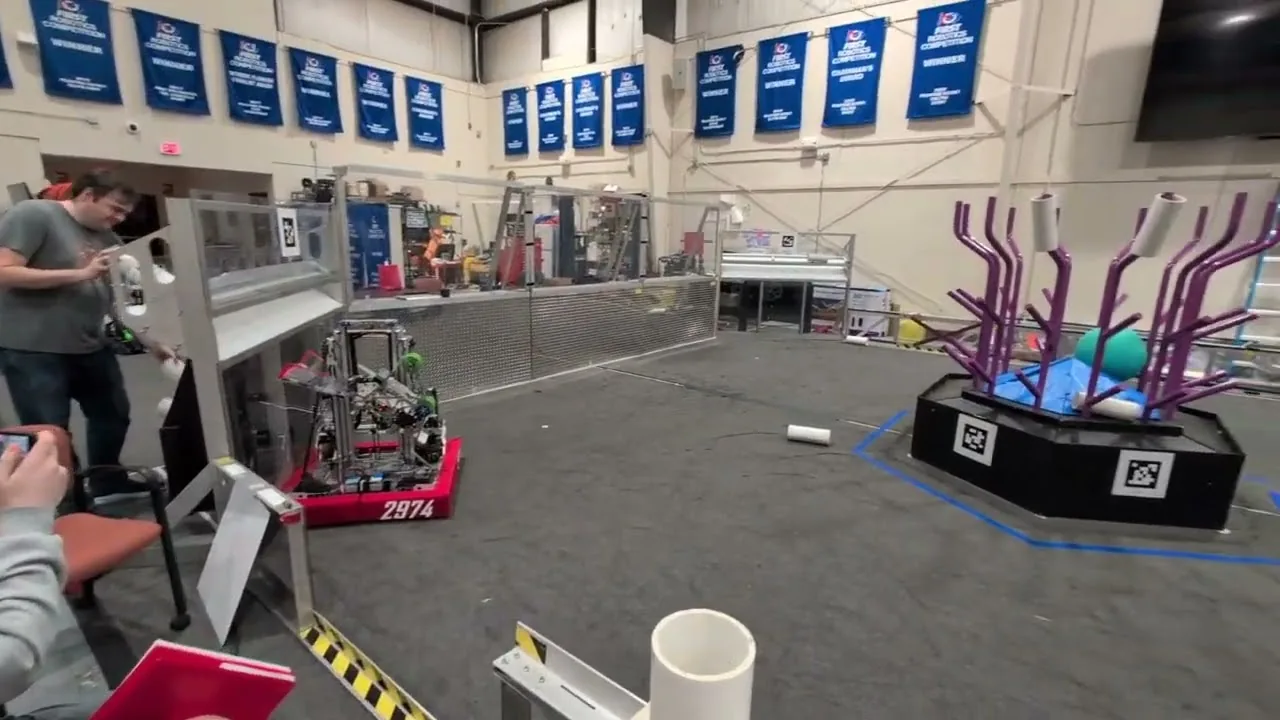
Results
Two event wins, at Dalton and Statesboro, and a district championship alliance with 1261 and 7538. Over the rest of the season the robot kept changing right up to the trip to Houston: a wider funnel, aluminum pulleys and camera-assisted autonomous routines, with the climber cut so its weight could go into intake performance.
As an Open Alliance team, Walton also shared its process openly, from the kickoff worksheet to the weekly updates, and passed intake and scoring-mechanism CAD to another team that asked for it.